About Methyl Hydroxyethyl Cellulose (MHEC)
The acronym
MHEC most commonly refers to
Methyl Hydroxyethyl Cellulose, a non-ionic, water-soluble white powder polymer derived from natural plant cellulose. It is widely valued as an additive in industrial manufacturing, building materials, and personal care products due to its high water retention, thickening capabilities, and structural stabilization qualities.
Wide Industrial ApplicabilityMHEC serves as a crucial additive in various sectors-its versatility as a thickener, binder, and film former makes it essential in construction, paints, detergents, and cosmetics. Its non-toxic and non-surface-active properties ensure safe and diverse application.
Customizable PerformanceAvailable in several grades-with viscosity ranging from 5,000 to 75,000 mPa.s and particle sizes of 80 or 100 mesh-MHEC's characteristics can be precisely tailored to suit specific requirements, ensuring optimal performance in each application.
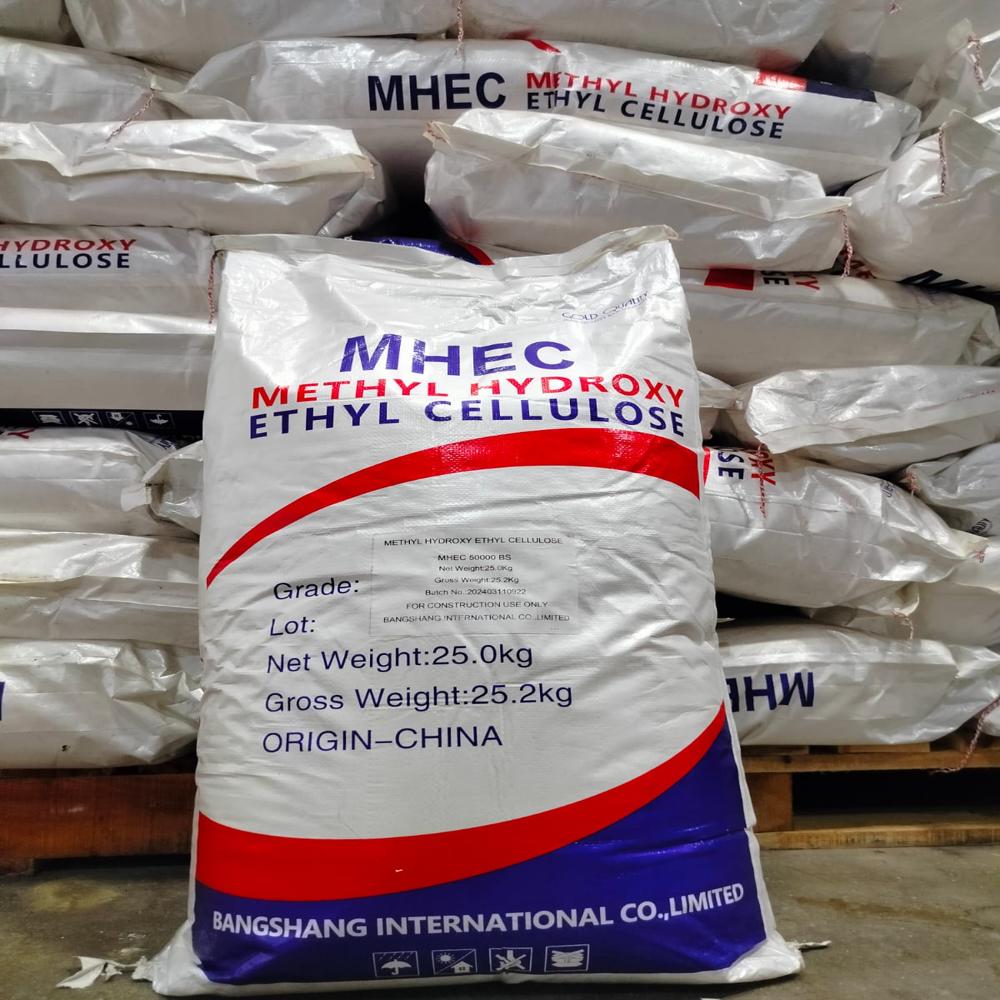
Stable and Safe StorageMHEC boasts a long shelf life of 2 years if kept in cool, dry conditions away from moisture. It is packed in 25kg kraft bags or custom packaging to maintain quality and prevent contamination, supporting extended storage and problem-free transport.
FAQ's of Methyl Hydroxyethyl Cellulose (MHEC):
Q: How is Methyl Hydroxyethyl Cellulose (MHEC) typically used in industrial applications?
A: MHEC acts as a thickener, binder, film former, and water retention agent in industries such as construction, paints, detergents, and cosmetics. Its excellent water solubility and stable viscosity make it suitable for improving texture, consistency, and workability in formulations.
Q: What are the primary benefits of using MHEC in construction materials?
A: MHEC enhances water retention, workability, and adhesion in construction materials such as mortars, plasters, and tile adhesives. It also helps control setting times, ensures even application, and improves durability without influencing the surface activity or causing toxicity.
Q: Where should MHEC be stored to maintain its quality and shelf life?
A: MHEC should be stored in a cool, dry place, away from moisture and direct sunlight. Properly packed in 25kg kraft bags or custom packaging, it maintains its stability and purity for up to 2 years.
Q: When is it necessary to select a specific viscosity or particle size grade of MHEC?
A: The choice of viscosity (5,000-75,000 mPa.s) and particle size (80 or 100 mesh) depends on your application's requirements. Higher viscosity enhances thickening or binding, while different mesh sizes affect dispersibility and mixing speed in final products.
Q: What is the process for dissolving MHEC in water for use in formulations?
A: MHEC readily dissolves in cold water. Gradually sprinkle the powder into water with stirring to prevent clumping. Maintain agitation until fully dispersed, ensuring a smooth, homogeneous solution suitable for subsequent formulation steps.
Q: Is MHEC safe for use in applications that require non-toxic and odorless additives?
A: Yes, MHEC is non-toxic, odorless, tasteless, and does not possess surface activity. It complies with safety standards and is ideal for applications that demand inert, safe, and reliable chemical additives.





 Send Inquiry


 Send Inquiry